My air purifier doesn't need the cloud anymore
Open standards instead of a vendor app and someone else's servers.
I have two Xiaomi air purifiers at home. They're good machines: quiet, effective, with a decent air-quality sensor. They help me a lot in the spring when the air is full of pollen. But to control them from my phone, I had to install Xiaomi's app, create an account, pick a server region, and let both purifiers stay connected to Xiaomi's cloud around the clock.
So switching on a fan in my own living room meant sending a request to a data centre I never chose, run under rules I can't see, and waiting for the answer. If those servers go offline, the terms change, or the app is dropped, the "smart" part stops working. Nothing would be wrong with the purifier itself. It's held hostage by its software.
I wanted the opposite: a device that speaks an open standard and works on my own network, whether or not any company's servers exist.
That standard is Matter, the smart-home language Apple, Google, Amazon, Samsung and hundreds of others agreed on. A Matter device needs no vendor app, no account and no internet. It works with Apple Home, Google Home or Home Assistant, and it keeps working whichever of those you use in ten years.
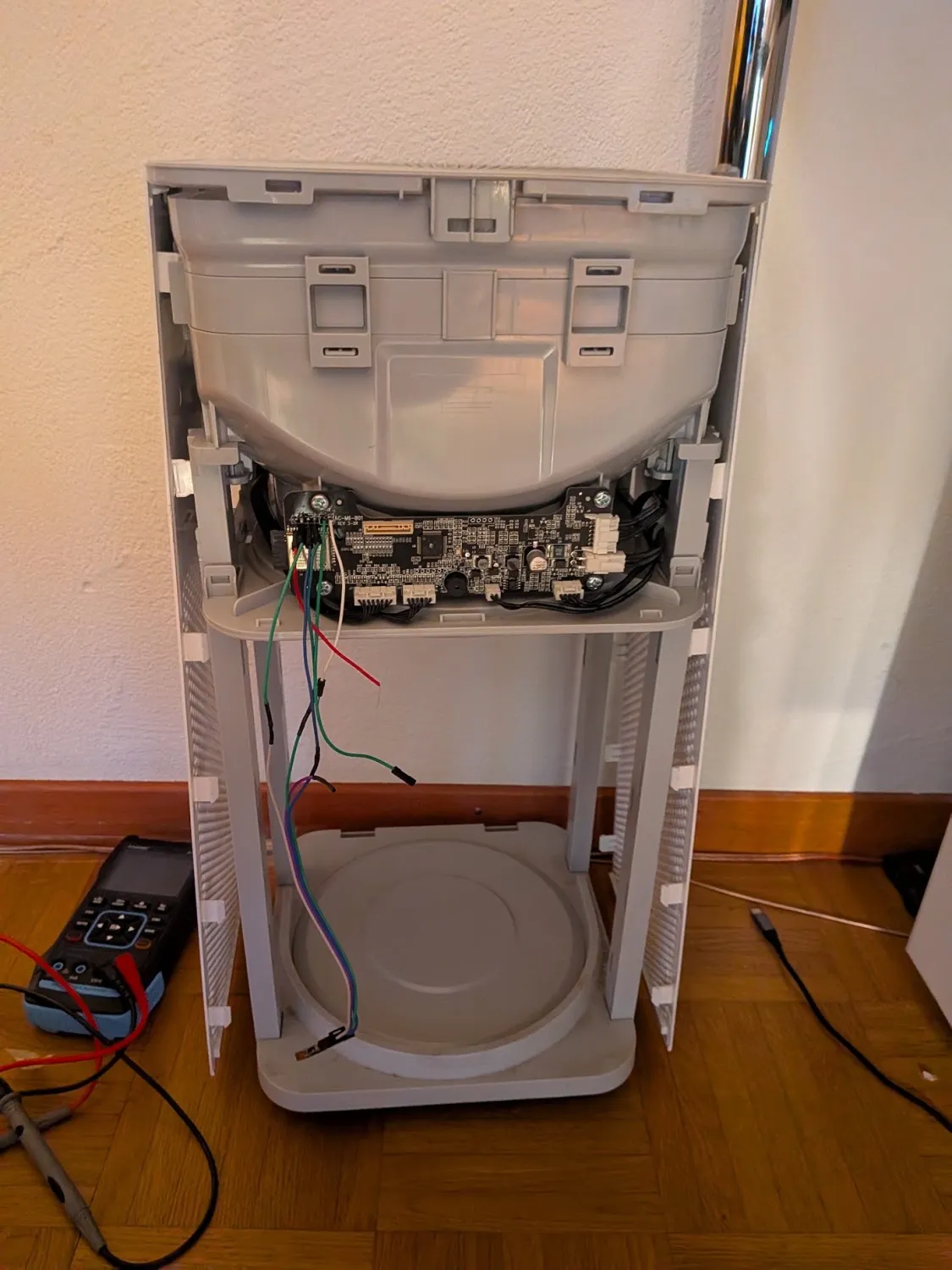
So I taught my purifiers to speak Matter. I didn't add hardware or solder anything. I only gave a chip that was already inside them new software.
The takeaway for anyone buying smart devices: ask whether it works locally, without an account, and with any app. Every "yes" means a device you actually own.
How it works (for the technically curious)
Inside each purifier are two chips. An STM32 microcontroller runs the motor, sensors, display and buttons. An ESP32 Wi-Fi module has a single job: pass messages between that STM32 and Xiaomi's cloud. The two talk over a serial line using a simple text protocol that Xiaomi documents for its partners.
The ESP32 is also the chip that Espressif's open-source Matter SDK targets. So the plan wrote itself: leave the purifier's controller untouched, and replace the Wi-Fi module's firmware with one that speaks Matter on one side and Xiaomi's serial protocol on the other.
The result is a new firmware built on ESP-IDF and esp-matter. It now runs on both a Mi Air Purifier 3H and a 3C, from a single image. At boot it asks the purifier's controller for a property only one of the two models has, and sets itself up for that model. In Home Assistant the purifier shows up as a standard Matter Air Purifier:
- power, Auto, Sleep, Low/Medium/High and a fine speed slider (Fan Control);
- PM2.5 and air quality, plus temperature and humidity on the 3H;
- filter life with a reset button (HEPA Filter Monitoring);
- device faults through Matter's standard diagnostics;
- updates over Wi-Fi that roll back on their own if a new version doesn't come up properly.

What real hardware taught me
Your router is part of the product. The purifier wouldn't join my Wi-Fi at first. My FRITZ!Box advertises a WPA3 compatibility mode and then doesn't follow it during the handshake. The fix was to ignore that hint. No spec would have told me. Reading disconnect codes late at night did.
Always keep a way back. The first step in the guide is a full backup of the original flash, so Xiaomi's firmware can be restored in minutes. That backup holds device keys and Wi-Fi passwords, so it never goes near the repository. Being able to go back is what makes it reasonable to try.
Stand on shoulders, and say so. Community teardowns had already mapped the chips, pins and protocol. Without them this would have taken months.
The bigger point
Plenty of good hardware ends up in landfill when a vendor's cloud is switched off. More of it keeps running, but sends every button press through servers its owner never chose. Neither is a hardware problem. The motor and the filter don't care where the commands come from.
Open standards move the decision about how long a device stays useful back to the person who bought it.
👉 Want to try it on your own purifier? The code: https://github.com/psytraxx/esp32-xiaomi-air-purifier-matter - you will find a lot useful information in the linked repositories as well - A lot of the work was done already and I can't be credited for this :)
Preview