Gravity Cube: an LED cube full of liquid light
A cube of 512 LEDs with a little lake of light inside it.
Tilt the Gravity Cube and the light runs downhill. Shake it and it sloshes against the walls. Spin it and it swirls the other way and climbs the sides. Double-tap it and the whole thing takes on a new colour.
It's an 8×8×8 LED cube: six 8×8 WS2812 panels, 384 LEDs in one chain, driven by a thumb-sized ESP32-S3 SuperMini with a BMI160 motion sensor on top. The idea isn't new. What I wanted was for the "liquid" to behave like an actual liquid rather than a pile of pixels sliding into a corner.
Real fluid physics, on a microcontroller
So the cube runs a proper fluid simulation. It's a FLIP solver: 512 particles carry the fluid's velocity around, a grid with one cell per LED keeps the flow incompressible, and each step the particles feel gravity plus the forces you get from holding a turning box (the ones that make your coffee swirl when you spin the mug). A light switches on where enough particles gather and off again only once they have clearly left, so a settled surface lies still instead of flickering.
One physics step takes about 17 ms on the ESP32-S3, which gives 55 frames a second. One core does the physics while the other pushes the previous frame out to the LEDs, so neither waits for the other.
How it works (for the technically curious)
- Motion. The BMI160 samples acceleration and rotation at 200 Hz into its FIFO. A complementary filter tracks which way is down: the gyro turns the estimate as you tilt, the accelerometer slowly corrects it. Whatever acceleration is left over is your hand moving the cube, and it's amplified before it reaches the fluid, so shaking sloshes nicely while tilting doesn't overshoot.
- Double tap. The sensor's own tap engine does the detection and raises an interrupt pin. A tap only counts after a moment of stillness, so shaking never changes the colour by accident.
- Same power in every colour. Every hue is scaled so its channels add up to the same total, so the cube draws the same current whatever colour it shows.
- Updates over Wi-Fi. New firmware goes to the cube with a single
curl. It is written to a second slot and only kept if it gets back onto the network and runs the main loop; otherwise the bootloader quietly goes back to the previous version. A broken build can't lock me out. - Tested off the device. Everything that doesn't touch hardware (the fluid, the colours, the panel map, the motion filter) builds on a PC and has unit tests, which run in CI on every push next to the firmware build.
Building it
Six panels on six faces leave many ways to put one on the wrong face or upside down. So the firmware has an assembly mode: each panel lights its centre in its own colour and each edge in the colour of its neighbour. On a correctly built cube every seam shows two matching strips, and a mistake is easy to spot.
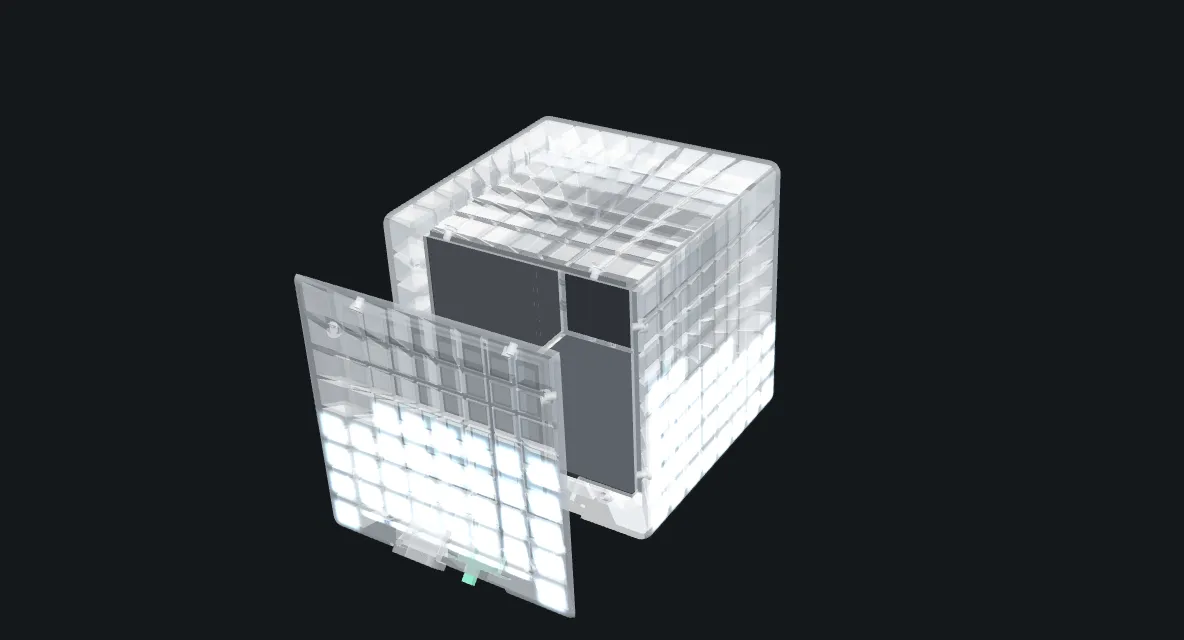
The enclosure, called Voxel Skin, is a translucent resin cube printed as an open box with a lid. Inside, a grid of thin baffles keeps each LED's light in its own square, so the surface reads as voxels rather than blur. The same generator builds two sizes, for rigid 65 mm panels and for flexible 80 mm ones, and you can turn both around in a 3D viewer.
The physics started life in Rust, in gravity-cube-rs. This version ports the solver to C on ESP-IDF 6.1.
👉 Firmware, wiring, enclosure and tests: https://github.com/psytraxx/gravity-cube-espidf
Preview